The differences between UPS systems and power generators, and above all how they complement each other
Whatever industry you’re in, whether it’s services, retail or manufacturing, it’s vital to protect your company’s data and the functionality of your network. We don’t mean hackers and cybercriminals (although that matters too!), but the problem of power outages.
When a power outage occurs, whether it’s caused by extreme weather, a system failure or a large-scale accident, your data is at risk of being lost, not to mention the damage to your computers and equipment.
The best way to protect yourself against this threat is to invest in a backup power source. There are two routes you can take: a UPS (not to be confused with the parcel delivery company!) and generators.
5 simple but important cybersecurity actions for small and medium business owners
Both have their similarities and differences, as well as their pros and cons. But what are UPSs and generators? And, above all, how do they complement each other?
What is a UPS?
A UPS (uninterruptible power supply) is a device that provides short-term backup power when the regular power source fails or when the voltage drops to an unacceptable level. Also known as a battery backup, it ensures that devices suffer no interruption in the event of a power outage.
UPSs are used mainly in IT, but they’re found in every sector, giving computers and other electronic equipment enough power to save data and shut down safely when a sudden power outage occurs.
A UPS is strictly a short-term backup power solution, because its runtime is generally between 10 and 15 minutes, although there are also models with longer runtimes.
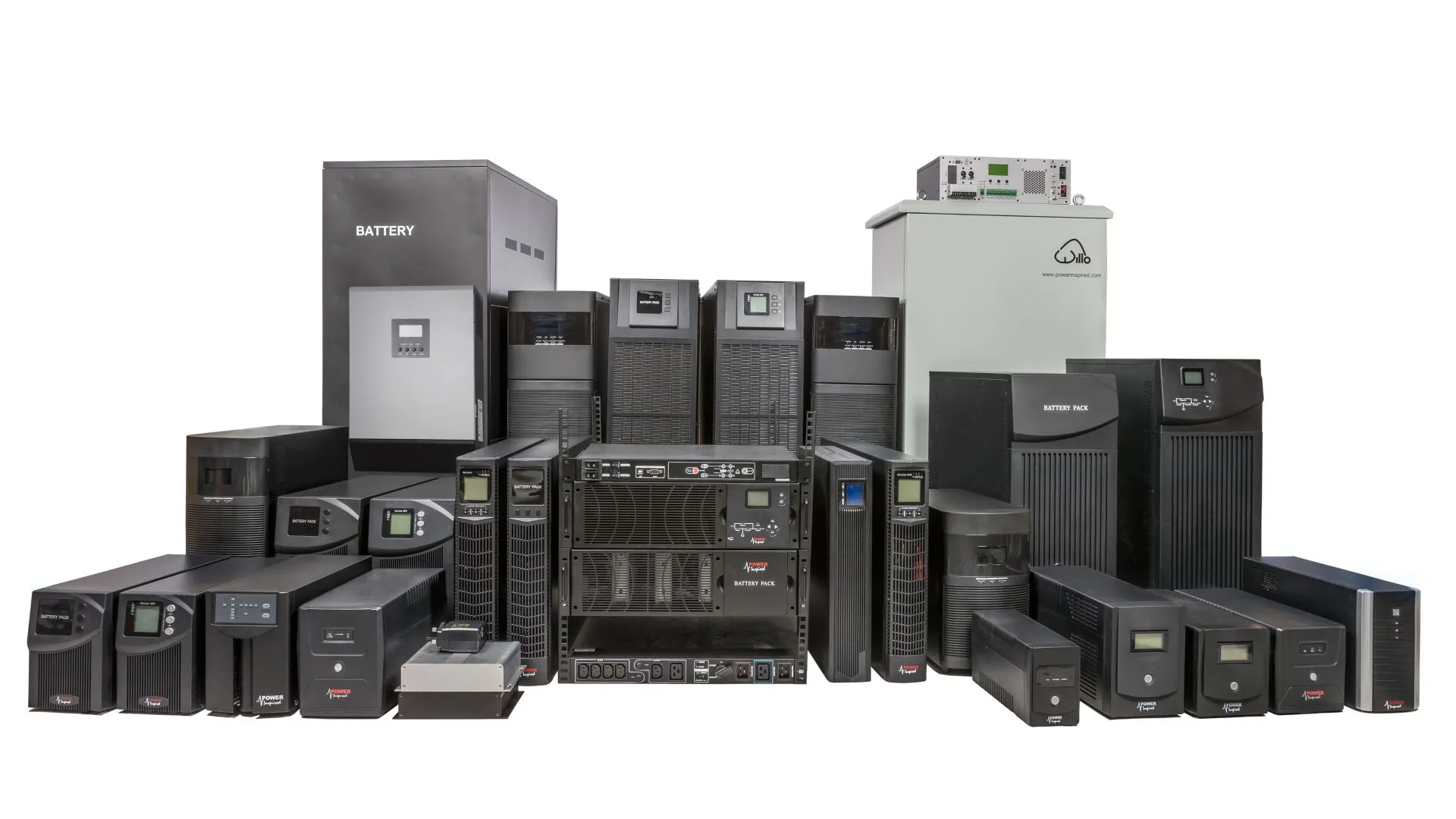
UPS systems fall into three categories:
Offline / standby
The simplest UPS topology, the offline (or standby) UPS system, switches to battery backup power in the event of a power supply problem, such as an outage, a voltage sag or a surge. When the mains voltage drops below or rises above safe levels, the UPS switches to the battery’s direct current, which it then converts to alternating current for the connected equipment. The switchover is fast enough that the protected equipment isn’t affected, but depending on the quality and the manufacturer’s specifications, this isn’t always guaranteed.
Line-interactive
A line-interactive UPS works similarly to a standby UPS, but it also has a variable-voltage autotransformer. This lets it correct minor voltage fluctuations, such as a sag or a surge, without switching to battery. The inverter stays in the circuit permanently, and when the power fails, the battery’s direct current switches from charging to powering the equipment.
Online / double conversion
In an online (or double-conversion) UPS system, the batteries are always connected to the inverter, so no transfer switches are needed. When a power outage occurs, the rectifier simply drops out of the circuit, and the batteries keep the power steady and unchanged. This ensures uninterrupted, constant and almost perfect power, regardless of the condition of the incoming electricity. Double-conversion UPS systems protect critical IT equipment, data centers, high-performance servers, large telecommunications installations and storage systems, as well as advanced network equipment, from damage caused by power or voltage problems.
What are power generators?
A generator is a device that converts mechanical energy into electrical energy, which is used in an external circuit. The most widely used are diesel generators.
A diesel generator is a specific type of generator set (genset) and consists of a diesel engine and an electric generator (usually an alternator), which work together to produce electricity.
Diesel engines are compression-ignition engines and can run on several fuels, depending on the configuration and the location. They usually run on diesel fuel, but some types are adapted for other liquid fuels or for natural gas.
Diesel generators can run without being connected to the power grid, which is why they’re often used as an emergency power source when the grid fails. They can also have secondary roles, such as supplying utility grids during peak periods or when there isn’t enough generating capacity.
What is the difference between a UPS and a generator?
As you can see, UPSs and generators have the same purpose: to provide backup power to electronic devices. During power outages, they can also help protect against damage to electronics, data loss, hard drive failure and premature wear of more delicate electronic equipment and accessories.
However, there are a few major differences between UPSs and generators, which we’ll look at below.
UPS:
- Almost instantaneous backup power.
- Short backup power supply, lasting between 10 and 15 minutes (there are options to extend this time).
- Its main function is to prevent a sudden loss of power.
- Starts automatically when it detects a failure of the main power supply.
- The battery charges from the AC mains.
- No noise.
- Produces no carbon emissions and is more environmentally friendly.
- Requires little maintenance: the batteries are replaced periodically.
- A cheaper alternative to generators.
Generators:
- Provide much longer backup power.
- Slower start-up time, usually 10 seconds or more.
- Can power much more equipment, or even entire buildings.
- Used mainly to supply electricity to power lines.
- Their main function is to convert mechanical energy into electrical energy.
- Run on diesel, other liquid fuels or natural gas (diesel generators).
- Produce noise, vibration and fumes.
- Produce carbon emissions.
- Can be portable or fixed (standby), depending on capacity.
- Require periodic maintenance of the diesel engine.
IT services for companies: tell me more →
For some companies, a power outage is just an inconvenience, and a backup power source that shuts down their systems in a controlled way is enough. An uninterruptible power supply (UPS) can provide this.
For other companies, it’s vital to keep operating normally, with systems running at all times, no matter how long an outage lasts. In this case, a backup generator complements the UPS and provides electricity for long periods. The generator runs as long as it has fuel, with a typical runtime before refueling of about 24 hours, depending on the tank and the consumption.
For generators and UPSs to work together successfully, it’s very important that the two are properly matched.
How do you choose a UPS for your company’s servers and network?
Choose the UPS based on the power your equipment draws, the runtime you need and how sensitive the protected equipment is:
- Power. Add up the consumption of the connected equipment (in watts) and choose a UPS with a margin of at least 20–30%. UPS power is given in VA and in W; for sizing, the W rating is what counts.
- Type. For office computers, a line-interactive UPS is usually enough. For servers, storage systems and critical equipment, choose an online, double-conversion UPS.
- Waveform. The power supplies of modern servers work best with a UPS that has a pure sine wave output.
- Automatic shutdown. Through a network card or a USB cable and the manufacturer’s software, the UPS can shut down servers and virtual machines in a controlled way before the battery runs out.
- Batteries. Classic lead-acid batteries are usually replaced every 3–5 years, and lithium-ion batteries last longer. Test the actual runtime periodically, because it decreases as the battery ages.
You’ll find a few models suitable for companies in the article on the best UPS for companies.
How do the UPS and the generator work together during a power outage?
The UPS takes over the power supply instantly, and the generator starts within a few seconds and takes over the load for the long term. When the power goes out, the UPS powers the equipment from its batteries, with no interruption. Meanwhile, the automatic transfer switch (ATS) starts the generator and, after a few seconds, transfers the load to it. When mains power returns, the ATS switches back and the generator shuts down.
To work well together, the generator is sized with a power margin over the UPS, and the UPS must tolerate the generator’s voltage and frequency variations. The sizing is done by a licensed electrician or by the designer of the installation. Test the generator periodically, under load, and check the fuel level.
Why does backup power matter in 2026?
Because a major power outage can completely halt a company’s operations: on April 28, 2025, Spain and Portugal were left almost entirely without electricity for several hours. For companies that fall under NIS2 (transposed in Romania by GEO 155/2024), business continuity is part of the mandatory risk management measures, and backup power for servers and the network is a natural part of it.
RezolvIT is an IT outsourcing company used to successfully securing and protecting its clients’ infrastructure. Whether we’re talking about laptops, desktops, servers or mobile devices, the company adopts and proposes innovative solutions to prevent the security threats that may arise.
Tell us what’s slowing you down. We’ll call you.
It takes 30 seconds, and a specialist will call you back within 2 business hours.
- free IT & AI audit, no obligation
- a report with risks and concrete recommendations
- a clear offer, with a fixed monthly plan
Prefer the phone? 031 432 8681